1. Introduction
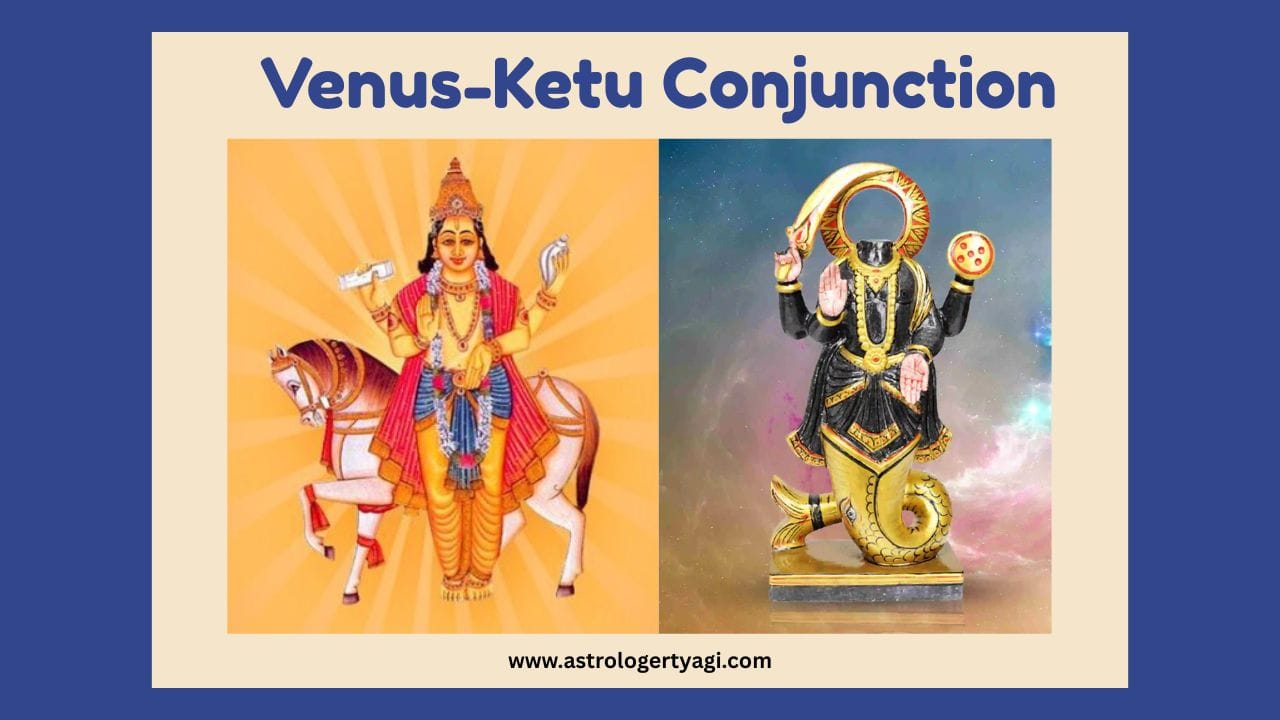
In the celestial cabinet of Vedic Astrology, the Venus-Ketu Conjunction is one of the most mysterious and spiritually charged unions. This conjunction represents the fusion of the Goddess of Desire (the source of love and beauty) and the Distant South Node (the representative of liberation and detachment). Mythologically, Venus is the teacher of the Asuras who understands all worldly pleasures, while Ketu is the headless body that seeks only to return to the divine source.
This is the “Yoga of the Spiritual Artist.” It represents a soul that is inherently “done” with superficial pleasures and is searching for a deeper, more soulful connection. While often feared for creating “breaks” in relationships or financial instability, this union eventually produces an individual of profound aesthetic depth and unconditional love. It is the path of the lover who learns that true beauty is found in the invisible, not just the material.
2. Understanding Venus (Shukra) in Astrology
Venus is the Kalatrakaraka, the significator of partnerships, and the force behind all things that bring joy and comfort to our senses.
Core Significations of Venus:
Love and Relationships: It rules our romantic attraction, marriage, and the capacity for harmony.
Wealth and Luxury: It governs money, jewelry, vehicles, and the fine arts.
Creativity: Venus is the muse; it rules music, dance, fashion, and aesthetic taste.
Vitality and Semen: Physically, it rules the reproductive system and the “spark” of physical attraction.
Devotion: On a higher level, Venus represents our capacity to love God through the beauty of creation.
3. Understanding Ketu in Astrology
Ketu is the Mokshakaraka, the “Significator of Liberation.” He represents the past, the subconscious, and the process of letting go.
Core Significations of Ketu:
Detachment: Ketu creates a “disconnect” from whatever it touches, making the native feel indifferent toward that area.
Past Life Karma: It represents skills we have already mastered in previous incarnations.
Spirituality and Occult: Ketu rules deep meditation, psychic abilities, and the desire to leave the material world.
Sudden Events: Known for “cutting” like a knife, it can bring sudden breaks or sudden spiritual realizations.
The Headless Body: Because Ketu has no head, it acts on intuition and instinct rather than logic or visual beauty.
4. The Venus and Ketu Conjunction: The Core Dynamics
When these two meet, it creates a dynamic of “Dissolving Desire.” Venus wants to hold on to pleasure, but Ketu acts like a vacuum, sucking the satisfaction out of material things.
The Psychological Challenge:
The primary struggle is Subconscious Discontent. The native often feels a “void” in their relationships. No matter how beautiful or wealthy a partner is, the Ketu-Venus person feels something is missing. In youth, this leads to a “searching” behavior, often entering and exiting relationships quickly because they are looking for a “divine love” that the material world cannot provide. There is often a sense of “Imposter Syndrome” in social settings—feeling like they are acting out a role of “happy person” while feeling detached inside.
The Closeness Factor: Degrees and Orb of Conjunction:
Exact (0° to 5°): The “Curse of the Unmet Desire.” Intense spiritual lessons through heartbreak or financial loss.
Close (5° to 12°): Highly creative. The native can produce art or music that feels “otherworldly” or hauntingly beautiful.
Wide (Over 15°): The influence is milder; the native is simply a bit private or unconventional in their tastes.
5. Positive Effects of Venus and Ketu Conjunction
Unconditional Love: Once they move past ego, these individuals are capable of the highest form of love—loving someone for their soul rather than their body or status.
Artistic Genius: Many world-class artists, photographers, and musicians have this. Ketu provides a “past life” mastery that makes their creativity feel effortless and unique.
Intuitive Healing: They have a natural ability to sense the pain in others and can excel in healing, counseling, or spiritual guidance.
Financial Detachment: Because they aren’t obsessed with money, wealth often flows to them unexpectedly (if other factors in the chart allow), as they don’t block it with greed.
6. Negative Effects of Venus and Ketu Conjunction
Relationship Instability: Sudden breakups or a tendency to attract partners who are “unavailable,” eccentric, or spiritually lost.
Lack of Contentment: A persistent feeling of “is this all there is?” even after achieving material success.
Financial Confusion: Mismanagement of funds or a tendency to be cheated in business deals because they don’t pay attention to the “fine print.”
Health Issues: Potential for issues with the reproductive organs, kidneys, or mysterious skin allergies that are difficult to diagnose.
7. Effects of Venus and Ketu Conjunction in Different Houses
1st House: The Enigmatic Presence
Appearance: The native often possesses a “haunting” or ethereal beauty. They don’t follow trends but have a timeless, mysterious style.
Psychology: Deeply private. They may feel like they are wearing a “mask” in social settings. Their identity is not tied to their looks, even if they are very attractive.
2nd House: The Fluidity of Value
Wealth: Money is viewed as “energy” rather than “security.” It often arrives in sudden waves followed by periods of total disinterest in accumulation.
Speech & Diet: A soft, almost whisper-like voice. They may have specific, “pure,” or highly unconventional dietary needs, often leaning toward asceticism or sattvic foods.
3rd House: The Detached Communicator
Creativity: A brilliant placement for poets or songwriters. They write about themes of longing, separation, or divine love.
Siblings: There is often a “karmic distance.” They may live far from siblings or feel they have nothing in common with them, yet there is no active malice.
4th House: The Spiritual Hermit
Domestic Life: Even in a palace, they feel like a guest. They often prefer a simple, clean, or remote home over a cluttered, luxurious one.
Mother: The mother may have been a spiritual figure, or the native feels a “soul-level” distance from her that forces them to find emotional security within themselves.
5th House: The Artist of the Past
Talent: This is “Pratibha” (innate genius). The native doesn’t “learn” art; they “remember” it from past lives.
Romance: They seek a “soulmate” connection and often find traditional dating shallow or exhausting.
6th House: The Healer of the Broken
Service: Instead of seeking a wealthy partner, they are drawn to those who need healing. They find beauty in the “cracks” of society.
Conflict: They settle disputes through grace and detachment. Legal or health issues often disappear the moment the native stops “fighting” them.
7th House: The Mirage of Partnership
The Lesson: This is a difficult placement for traditional marriage. The native may experience a “sudden start and sudden stop” in relationships.
The Ideal Partner: They need someone who understands that “love” is a spiritual practice, not just a physical or legal contract.
8th House: The Occult Aesthetic
Hidden Gains: They may inherit wealth from mysterious sources or through the death of a “hidden” relative.
Tantra: They are drawn to the deep, transformative side of intimacy and the occult. They find beauty in the “dark” or the “hidden” aspects of life.
9th House: The Devotional Traveler
Philosophy: They love God through beauty (Bhakti Yoga). Their religion is not about rules, but about the aesthetic of the Divine.
Travel: They are “pilgrims,” not “tourists.” Every trip is a search for a deeper meaning.
10th House: The Reluctant Celebrity
Career: They often succeed in fashion, art, or social work. Because they don’t crave the limelight, the public is naturally drawn to their “cool” and detached aura.
Authority: They lead with a “soft power” that others find impossible to resist.
11th House: The Spiritual Networker
Friendships: They attract eccentric, artistic, or saintly friends. Their social circle is a “Soul Tribe” rather than a networking group.
Gains: Money often comes through “non-traditional” means—royalties, spiritual teaching, or creative “flukes.”
12th House: The Cosmic Lover
Solitude: This is the highest placement for a mystic. They find more pleasure in meditation or dreams than in the real world.
Bed Pleasures: This can lead to celibacy by choice or a very “transcendental” experience of intimacy that borders on a religious experience.
8. Factors Modifying the Conjunction’s Effects
1. Sign Placement: The Environmental Filter
The sign determines the “frequency” at which Venus operates. Because Ketu has no head (logic) and only feels (intuition), it intensifies the inherent qualities of the sign it occupies.
Venus in Pisces (Exalted): The Saintly Lover
In Pisces, Venus reaches its highest vibration of unconditional love, and Ketu is highly comfortable in this watery, spiritual sign.
The Spiritual Win: Here, the material “limitations” of Ketu don’t feel like a sacrifice. The native doesn’t want a “standard” relationship; they want a soul-merger.
Transcental Romance: They view their partner as a manifestation of the Divine. This is the placement of the “Bhakta” (Devotee). Even if they are betrayed or separated from a lover, they do not become bitter; they turn that pain into poetry or prayer.
Non-Possessiveness: They master the art of “holding a bird with an open palm.” Their love is vast, oceanic, and lacks the sticky, possessive quality of the ego.
Venus in Virgo (Debilitated): The Critical Ascetic
In Virgo, Venus is in the sign of logic, detail, and perfectionism. When Ketu joins a debilitated Venus, it creates a “rejection loop.”
The Search for the Impossible: The native looks for a partner who is perfectly pure, perfectly organized, and perfectly spiritual. Because no human can meet these standards, Ketu provides the “reason” to detach.
The “Flaw” Focus: Instead of seeing beauty, the native’s eye is drawn to the one thing that is wrong. This often leads to a life of “serial singleness” or a feeling of being “unlovable” because the world isn’t “clean” enough.
The Path to Mastery: The only way to win with this placement is to turn the critical eye toward Healing. If the native uses this precision to become a doctor, a therapist, or a spiritual healer, the “debilatation” is cancelled by the service they provide.
2. Jupiter’s Aspect: The Alchemist of Heartbreak
Jupiter is the Guru. Its 5th, 7th, or 9th aspect acts as a “divine bridge” that connects the disconnected Ketu back to a higher purpose.
From “Pain” to “Wisdom”
The Healing Gaze: Without Jupiter, Venus-Ketu can feel like a “starved” heart—a feeling that “love always leaves me.” Jupiter’s aspect provides the Philosophy to understand why the love left. It turns a “breakup” into a “breakthrough.”
The Wisdom of Experience: The native realizes that their disappointments in relationships were actually “lessons in disguise” to steer them toward a more profound, internal joy.
The Spiritual Teacher of Love
Guidance for Others: Because these individuals have felt the “void” of Ketu and the “desire” of Venus, they become incredible counselors. They don’t give “fairytale” advice; they give Real Wisdom.
The Marriage of Finance and Dharma: Jupiter (Wealth) aspecting Venus-Ketu (Unconventional Finance) often leads to someone who teaches “Spirituality of Abundance”—helping people heal their “poverty consciousness” or their “unworthy” feelings regarding money.
3. Comparison of Modifying Factors
| Factor | Primary Conflict | The Evolutionary Outcome |
| Pisces Placement | Fantasy vs. Reality | Divine Ecstasy. The native finds beauty in the unseen and the eternal. |
| Virgo Placement | Perfection vs. Flaw | Sacred Service. The native finds beauty in healing the broken and imperfect. |
| Jupiter’s Aspect | Loneliness vs. Solitude | The Sage of Relationships. The native guides others through the labyrinth of human desire. |
4. The “Degree” Factor (The Deep Detail)
Close Conjunction (0° – 3°): The “Eclipse” of Venus is total. The native may experience a “Vairagya” (disgust with worldly pleasures) early in life.
Wide Conjunction (7° – 12°): The native fluctuates. They spend half their time chasing beauty (Venus) and the other half wanting to run away to the mountains (Ketu).
The Esoteric Secret: A modified Venus-Ketu conjunction is the mark of a “Tantric Soul.” It is someone who is learning that the ultimate “Relationship” is not between two people, but between the individual soul (Atman) and the Divine Beauty (Sundaram).
9. Timing the Effects: Dasha Periods
A. Venus Mahadasha – Ketu Antardasha: “The Emotional Liquidation”
Venus is a long, 20-year cycle focused on building, enjoying, and relating. When Ketu enters as the sub-period lord (Antardasha), it acts as a surgical strike on everything you’ve built that isn’t true to your soul.
The “Cut” of the Cord: This is frequently a time of “forced exits.” If you are in a relationship that serves your ego but starves your soul, Ketu will create a situation—a sudden realization, a cooling of feelings, or an external event—that severs the tie. It feels cold, but it is deeply compassionate.
Material Disenchantment: You may look at your expensive car, your wardrobe, or your social status and suddenly feel a profound sense of “So what?” The “glitter” of the world loses its shine.
Creative Incubation: This is not a time for public launches. It is a time for “the basement work.” Because the world isn’t distracting you with parties or praise, you can channel your loneliness into a masterpiece. Many world-class albums or books are written in this specific 1.2-year window.
The Cleansing: Think of this as a “fast” for the heart. You are being emptied of “junk” emotions (codependency, greed, vanity) so that you are light enough for the next phase of your life.
B. Ketu Mahadasha – Venus Antardasha: “The Sudden Bloom”
This is the “Light at the end of the Tunnel.” After the long, dry, and often confusing transit through the beginning of a Ketu Mahadasha, the Venus sub-period arrives like a sudden spring rain in a desert.
The Soulmate Encounter: This period often brings a person into your life who feels incredibly familiar. It isn’t the “hot and heavy” romance of Mars; it is the “quiet and deep” recognition of Ketu. It feels like meeting a friend from a thousand years ago.
The “Unasked For” Fortune: In Ketu-Venus, money often comes when you stop chasing it. Because you’ve spent the previous years learning to live without, the universe suddenly hands you a “gift”—a settlement, a bonus, or an inheritance.
The Condition of the Gift: This is the most important part. The universe says: “I will give you this beauty, but you must keep your hands open.” If you try to become possessive or “greedy” with the new partner or the new money, Ketu will immediately “ghost” the blessing.
Aesthetic Awakening: You may suddenly feel the urge to surround yourself with beauty—flowers, art, or sacred music—but in a way that feels like a tribute to the Divine rather than a display of wealth.
Comparison of the Dasha Experience
| Feature | Venus – Ketu (The Exit) | Ketu – Venus (The Entry) |
| Dominant Feeling | “I am losing what I love.” | “I am finding what I forgot.” |
| Action Step | Release. Let the dead leaves fall. | Receive. Accept the gift with humility. |
| Financial State | Spending money on “Internal” needs (Healing). | Receiving money from “External” sources. |
| Social Life | Shrinking to a small, private circle. | Expanding to include “Soul-level” connections. |
The “Karmic Weight” of the Timing
If you are currently in these periods, the physical world will feel “thin.” You might feel like you are walking between two worlds. The best way to navigate this is to avoid making “hard-boiled” material commitments.
10. Transit of Planets Over Venus-Ketu Conjunction
A. The Annual Venus Return: “The Monthly Recharge”
Once a year, the transiting Venus returns to the exact spot where it sits in your birth chart. For someone with a Venus-Ketu conjunction, this is rarely a “party month.” Instead, it is a period of Aesthetic and Emotional Calibration.
Heightened Sensitivity: You become a “psychic sponge.” You might find yourself unable to be around “loud” people, bright lights, or harsh environments. Your soul is looking for high-vibrational beauty.
Creative Downloads: This is the best window for “automatic” creativity. You don’t “try” to paint or write; it flows through you. Because Ketu is the “pipe” and Venus is the “water,” the art created during this transit often feels like it was dictated by a higher power.
The Review of Value: You will look at your current possessions and relationships and ask: “Does this reflect my true soul, or is this just clutter?” It is a month for “emotional spring cleaning.”
B. The Ketu Transit (Every 18.5 Years): “The Great Eraser”
This is a massive life event. When transiting Ketu returns to your natal Venus-Ketu (at ages 18-19, 37-38, and 55-56), it initiates a Major Identity Pivot.
The “Relationship Exit” or “Career Death”: Ketu’s return is like a cosmic “Reset” button. If you have been staying in a career just for the money (Venus) or a relationship just for the security, this transit will make it impossible to continue. The “falseness” of the situation becomes unbearable.
The Shift to Meaning: You don’t just quit; you move toward something “meaningful.” At age 37-38, many people with this conjunction leave high-paying corporate jobs (Venus) to become therapists, yoga teachers, or organic farmers (Ketu).
The Shedding of Skin: You literally look different after this transit. You may change your name, your style, or your lifestyle. You are shedding the “Venusian” expectations of society to reveal the “Ketu” truth of your spirit.
C. The Saturn Transit (The 2.5-Year Weight)
When Saturn transits over your Venus-Ketu, it brings Reality to the Romance.
The Commitment Test: If you are in a relationship, Saturn forces it to become “legal” or “structured.” It removes the “mirage” of Ketu and asks: “Can you handle the daily work of this love?”
Financial Discipline: Saturn dries up the “unconventional” gains of Venus-Ketu and forces you to build a long-term, disciplined financial structure.
Summary of Transit Effects
| Transit | Frequency | The “Trigger” | The Result |
| Venus Return | Every Year | A feeling of “otherworldliness.” | New art, music, or a brief retreat. |
| Ketu Return | Every 18.5 Years | A “spiritual crisis” regarding desires. | A total change in life direction or partner. |
| Jupiter Transit | Every 12 Years | A sudden “blessing” or expansion. | Turning a hobby into a spiritual career. |
| Saturn Transit | Every 29 Years | A feeling of “loneliness” or burden. | Solidifying a spiritual path into a reality. |
Why “Transits” Matter for Venus-Ketu
Because Ketu is a “chaya graha” (shadow planet), it is usually dormant. It needs a “physical” planet like Venus or Saturn to walk over it to make its effects felt in the physical world. Without these transits, the Sun-Ketu or Venus-Ketu native just feels a “vague sense of detachment.” The transit turns that feeling into an event.
11. Venus and Ketu Conjunction in Different Nakshatras
A. Venus-Ruled Nakshatras (Bharani, Purva Phalguni, Purva Ashadha)
The Theme: The Alchemist of Desire
When Venus and Ketu are in a Venusian Nakshatra, the energy is “self-reflecting.” Venus is in its own star, so the desire for beauty and pleasure is very strong, but Ketu’s presence creates a “leaky bucket” effect.
Creative Release or Suffocation: These natives have an immense amount of “Shakti” (creative power). Because Ketu is the “headless” planet, this energy doesn’t have a logical exit. If the native does not have a creative outlet—like dance, painting, or music—the emotional energy builds up like steam in a pressure cooker. They may feel “choked” or “heavy” in their chest.
Bharani (The Bearer): This is the star of birth and death. The Venus-Ketu native here often experiences “creative rebirths.” They might create something, destroy it, and then build something even more beautiful from the ashes.
Purva Phalguni (The Relaxed): Here, the struggle is with luxury. The native loves comfort but feels guilty for enjoying it. They must learn to view “rest” and “beauty” as spiritual necessities rather than egoic indulgences.
The Lesson: To learn that Art is a Form of Prayer. When they create, they aren’t doing it for “likes” or fame; they are doing it to move the divine energy through their body.
B. Ketu-Ruled Nakshatras (Ashwini, Magha, Mula)
The Theme: The Ancestral Heart-Cleaner
When Venus and Ketu are in Ketu’s own stars, the conjunction becomes a Karmic Vacuum. This is a heavy but holy placement. You are not just living your own life; you are acting as a “filter” for your ancestors.
Ancestral Healing: The native often finds themselves repeating the relationship patterns of their parents or grandparents (infidelity, loss, or total isolation) only to be the one who finally “breaks the cycle.” You are clearing the “debts of love” that your lineage left unpaid.
Magha (The Throne/The Ancestors): In Magha, Venus-Ketu creates a person who seeks “Noble Love.” They may feel that their family’s pride or past “royal” status (real or imagined) interferes with their happiness. They are here to learn that true “Royalty” is found in the spirit, not in the family name.
Ashwini (The Healers): Here, Venus-Ketu grants the “Miraculous Touch.” The native has the power to heal the relationships of others. They are the “Relationship Doctors.” They often understand the mechanics of love so well because they have experienced its “Ketu-like” void so deeply.
Mula (The Root): This is the most intense. It involves “uprooting” false desires. The native may experience a total destruction of their romantic life at least once, only to find a “Root” (Mula) of love that is indestructible and eternal.
Comparison of Nakshatra Flavors
| Nakshatra Ruler | Core Driver | The “Shadow” | The “Siddhi” (Gift) |
| Venus-Ruled | Need for Expression | Feeling “stifled” or blocked. | Creating “Divinely Inspired” Art. |
| Ketu-Ruled | Need for Resolution | Carrying family “baggage.” | Ending a generational curse of loneliness. |
12. Remedies for Venus and Ketu Conjunction
Serve the Blind: Venus rules vision and Ketu is headless (blind). Serving the blind or the disabled heals this karma.
Offer White Flowers: Offering white flowers at a temple or in moving water helps soothe the “cutting” energy of Ketu.
Practice “Non-Attachment”: Consciously practicing the idea that “I love you, but I do not own you” is the best behavioral remedy.
Creative Expression: Don’t let the Venus energy sit still. Paint, sing, or dance to move the energy.
Suggestion: Sun-Saturn Conjunction In Astrology
13. Free Will vs. Destiny: The Divine Hunger
The Destined Reality: The “Glass Wall”
Destiny (Prarabdha Karma) has placed a “glass wall” between you and the superficial world. You may see others enjoying mindless consumption, shallow romances, or purely material status, but you find you cannot “taste” the same satisfaction.
The Divine Hunger: You were born with a pre-programmed “lack” in the material department. This isn’t because you are unlucky, but because your soul has already “graduated” from the basic lessons of Venus. You are destined to find a “five-star meal” of the spirit, so the “fast food” of the world tastes like ash to you.
The “No-Head” Love: Because Ketu is the headless planet, you are destined to experience “unreasonable” emotions. You might fall in love with someone’s soul while ignoring their status, or you might walk away from a “perfect on paper” life because it lacks Prana (life force).
The Role of Free Will: Gratitude vs. Loneliness
Your Free Will (Kriyamana Karma) lies entirely in how you perceive your sensitivity.
The Choice of Loneliness: If you use your free will to focus on what is “missing,” you fall into the Ketu shadow. You feel misunderstood, isolated, and “unlucky” in love. You see your inability to be “normal” as a curse.
The Choice of Gratitude: If you choose to see through the “Ketu lens,” you realize you have spiritual X-ray vision. You can walk into a room and see the hidden beauty in a stranger, the art in a falling leaf, or the divine geometry in a difficult situation.
The Shift: Free will allows you to say: “I am not lonely; I am in solitude with the Divine.” When you make this shift, the “hunger” doesn’t go away, but it becomes a “Sacred Longing” that fuels your creativity instead of your depression.
Suggestion: Jupiter-Saturn Conjunction In Astrology
14. Conclusion: The Yoga of the Divine Rose
The “Yoga of the Divine Rose” is a metaphor for the specific spiritual path of a Venus-Ketu native. A rose is beautiful (Venus), but it is guarded by thorns (Ketu), and its scent is intangible—it cannot be held, only experienced.
The Transcendence of Touch
This conjunction eventually teaches the native that possession is the death of beauty. * In your early years, you may have tried to “own” people or things, only for them to slip through your fingers like sand.
In your later years, this Yoga produces a “refined heart.” You learn to appreciate the “rose” without needing to pluck it. You find that you can love someone more deeply when you don’t require them to belong to you.
The “Fire-Tested” Soul
Because this conjunction brings “early trials”—often involving heartbreak, financial “resets,” or social isolation—it produces a soul that is fireproof.
You have lived through the “death” of your desires, and you are still standing. This makes you incredibly brave.
You become a person who can sit in a room with a grieving friend and not be afraid, because you know the “Ketu Void” intimately.
Final Synthesis
The Venus-Ketu conjunction is the mark of the “Spiritual Aesthetic.” It is the transition from Kama (Desire) to Prema (Divine Love). It proves that:
Beauty is a portal, not a destination.
Love is a state of being, not a transaction between two people.
Freedom is the ability to enjoy everything while needing nothing.
The Final Word: You are a channel for a beauty that doesn’t belong to this earth. Your task is not to find “The One” in a person, but to find “The One” in the silence of your own heart.
Suggestion: Mercury-Venus Conjunction In Astrology
15. FAQs
Q1: Will I ever get married?
Yes, but your marriage will work best if it is based on spiritual friendship rather than just physical attraction.
Q2: Why do my relationships end suddenly?
Ketu “cuts” what is no longer serving your soul’s growth. Each break is a step toward your true self.
Q3: How can I improve my finances?
Stop chasing money. Focus on your unique creative “mastery,” and the money will follow as a byproduct.
Suggestion: Sun-Ketu Conjunction In Astrology